
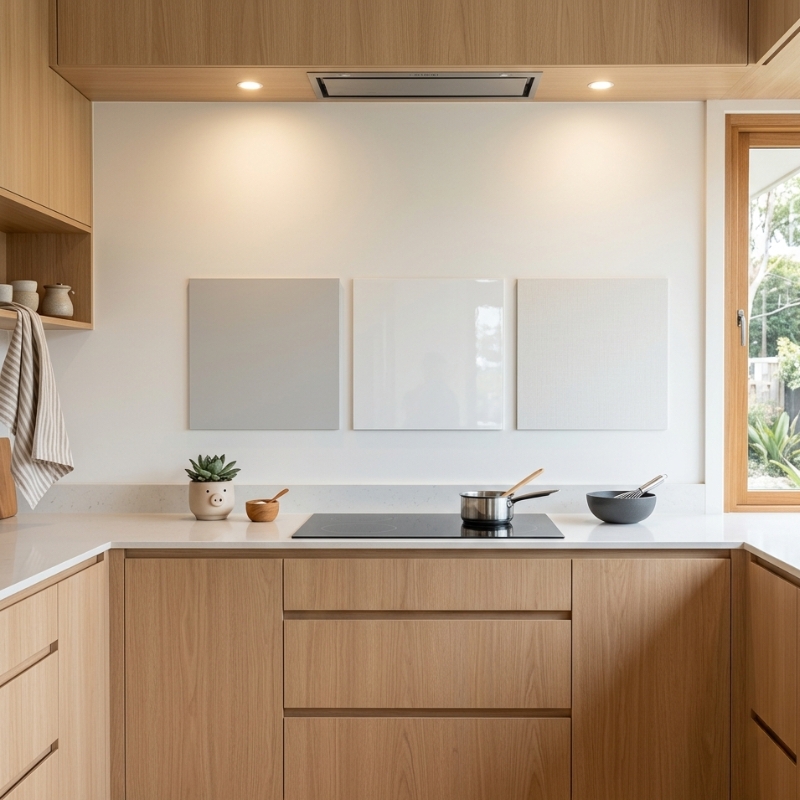
If you’re choosing a finish for the kitchen back wall (the “splash zone” behind the sink and cooktop, including your glass splashback), it’s easy to get stuck between what looks best in a showroom and what still looks good after months of weekday dinners, weekend baking, and “quick wipes” that aren’t always that quick.
In real homes across the Central Coast, NSW, the back wall cops a predictable mix of:
• cooking oils that turn into a fine sticky film
• steam and condensation (especially in cooler months or with lots of boiling)
• splatters from sauces, curries and frying
• finger marks from kids reaching for switches or leaning while chatting
• light reflection from windows and downlights that can either flatter the space or highlight every streak
This guide breaks down matte vs gloss vs textured finishes with the unfiltered cleaning reality—plus what typically changes after about six months of everyday life.
Start here: what “finish” really means in a kitchen
“Finish” usually refers to the surface sheen and texture you see and feel. In kitchens, the finish can sit on many materials (paint, tile, stone, metal, glass, laminate panels), but the finish behaves in similar ways:
• Sheen (matte to high gloss): affects how light reflects, and how visible smudges and streaks are
• Texture (smooth to heavily textured): affects how easily grease and grime can be wiped away
• Seams and joins: grout lines and panel joins can change the cleaning effort more than the finish itself
• Colour and pattern: can disguise marks, but can also make “patchy cleaning” look worse
The right pick depends less on trend and more on your cooking style, lighting, and how you prefer to clean.
Quick decision framework
Choose your finish based on what you want to “win” at:
• Want the wall to wipe clean fastest? Lean smooth + higher sheen.
• Want the wall to hide fingerprints and minor scuffs? Lean lower sheen or patterned finishes.
• Want the wall to hide streaks and water marks? Lean mid-sheen or subtle pattern.
• Want the wall to avoid trapping grime? Avoid deep texture and lots of grout.
Matte finishes: calm, modern, and forgiving… until grease builds up
Matte finishes are popular for modern kitchens because they look soft and refined. They reduce glare, they don’t bounce light into your eyes, and they can make cabinetry and benchtops feel more “premium”.
Pros of matte on the kitchen back wall
• Low glare: great for kitchens with strong sunlight (north- or east-facing windows are common in many Central Coast layouts)
• Hides streaks from uneven wiping, especially compared with high gloss
• Softens busy colour schemes: matte can balance bold benchtops or patterned flooring
• Photographs well: fewer hot spots from downlights
Cons of matte in real kitchens
• Grease can cling: matte surfaces can hold onto oils more than you expect, especially if the surface has micro-texture
• Spot-cleaning can show “clean patches”: some matte materials can look darker or lighter where you’ve scrubbed
• Scuff marks can be harder to buff out: you can’t always “polish” a matte surface without changing the appearance
Cleaning reality: what you’ll notice after 6 months
In the first few weeks, matte looks tidy even if you’re not wiping constantly. After a few months, the most common complaint isn’t fingerprints—it’s a slightly dull or uneven look in the busiest areas (behind the pan, near the sink tap, around power points). That’s usually a thin film of cooking oil and airborne dust that sticks to it.
If you cook with a lot of oil (stir-fries, shallow frying, schnitzels, bacon), matte can look “fine” day to day, but it often needs a more deliberate degrease occasionally to stay crisp-looking.
Matte cleaning tips that actually work
• Do a quick wipe with warm water + a small amount of dishwashing liquid (not too much—more soap can mean more residue)
• Use a clean microfibre cloth, then finish with a second dry cloth
• If grease has built up, use a kitchen-safe degreaser sparingly, then rinse/wipe again so it doesn’t leave a haze
• Avoid abrasive pads on matte finishes—scrubbing can create shiny patches
Q&A: Is matte or gloss easier to clean in a kitchen?
Matte can feel “forgiving” because it hides a lot day to day, but glossy, smooth surfaces typically wipe clean faster. Matte often needs a more thorough degreasing occasionally to prevent that slightly uneven, film-like look in heavy-use zones.
Gloss finishes: bright, wipeable, and honest about every fingerprint
Gloss finishes are all about reflection. They can make a kitchen look bigger and brighter, and they can feel very easy to clean, because many glossy surfaces are smooth.
Pros of gloss on the kitchen back wall
• Fast wipe-down: smooth, glossy surfaces are usually the quickest to clean
• Brightens the room: reflects light, helpful for darker kitchens or those with limited natural light
• Makes small kitchens feel larger: reflection adds visual depth
• Looks sharp with modern cabinetry: especially in white, neutral, or bold colours
Cons of gloss in real kitchens
• Shows fingerprints: especially at kid height, near switches, and along edges
• Shows streaks if you “half clean”: a rushed wipe with the wrong cloth can leave smears
• Downlights can highlight marks: if your lighting is strong, you’ll see the reality more clearly
• Water spots can stand out, especially near the sink if you have hard water marks or splash frequently
Cleaning reality: what you’ll notice after 6 months
Gloss tends to perform brilliantly in terms of hygiene and wipeability—but it’s a truth-teller. If you have kids who touch the wall with jam hands or you’re constantly turning on switches mid-cook, you’ll notice finger marks more than you would on matte.
After six months, the most common “gloss regret” is not the cleaning time (it’s usually quick), but the fact you can see when it hasn’t been done.
Gloss cleaning tips to avoid streaks
• Use a slightly damp microfibre cloth first, then a second dry microfibre to buff
• Skip paper towel for final wiping—it can leave lint and drag marks
• If you use a spray cleaner, apply it to the cloth (not the wall) to avoid overspray and drip trails
• For stubborn marks, warm water + dish soap is often better than strong cleaners that leave residue
Q&A: Why does my glossy back wall look streaky even after cleaning?
Usually it’s one of three things:
• too much cleaner (residue dries streaky)
• a single cloth doing both “wash” and “dry”
• grease film that needs a proper degrease first, then a rinse wipe, then a dry buff
Textured finishes: great at hiding minor marks, but can trap grime
Textured finishes are chosen for character—think subtle ripples, stone-like surfaces, tactile tiles, or patterned panels. They can be fantastic visually, especially if you want warmth or a natural look.
Pros of textured finishes on the kitchen back wall
• Hides fingerprints and small marks: texture breaks up reflections and disguises smudges
• Adds depth and style: great for coastal, Hamptons, or earthy kitchen looks common around the Central Coast
• Less “precious” appearance: you won’t notice every tiny touch the way you might with gloss
Cons of textured finishes in real kitchens
• Grime can collect in valleys: grease + dust can settle into texture and become harder to remove
• Cleaning takes longer: you may need a soft brush or extra passes with cloths
• Can discolour unevenly: especially if oils build up in one area more than another
• If tiled, grout is the real effort: grout lines can be the most high-maintenance part of a “textured look”
Cleaning reality: what you’ll notice after 6 months
Textured finishes often look great for months—until you realise the surface isn’t just “hiding” marks; it can also be storing them.
After six months, homeowners often notice:
• darkening in the most used cooking zone
• sticky feeling in certain spots that don’t wipe clean easily
• a need for periodic deeper cleaning (soft brush + gentle degreaser)
If you love texture, aim for subtle texture rather than deep grooves in the highest-splatter zones.
Q&A: Do textured finishes trap grease?
They can. The more pronounced the texture, the more places grease can lodge. If the wall is in a heavy-frying kitchen, a deeply textured finish can become a “slow build-up” surface that needs more regular deep cleaning.
The “six-month test”: what changes once daily life kicks in
Most kitchen back walls look perfect right after installation. The real test is what happens when:
• The rangehood isn’t always used on full power
• someone wipes the wall with whatever cloth is nearest
• sauce splatters dry while you’re busy
• salt air and humidity (common in coastal areas) mix with cooking oils
Here’s what tends to show up over time:
Fingerprints
• Most visible on gloss
• Less visible on matte
• Least noticeable on textured/patterned, unless grime builds in grooves
Grease film
• Most annoying on matte if you don’t degrease occasionally
• Easiest to remove on smooth gloss
• Can become embedded on textured surfaces
Streaks and wipe marks
• Most visible on gloss, especially under downlights
• Moderate on matte depending on material
• Usually least visible on textured/patterned, unless the pattern makes patchy cleaning stand out
Discolouration in hot/splatter zones
This depends more on material and heat suitability than on finish alone—especially behind cooktops.
Behind the cooktop: finish is only half the story
Behind a cooktop, the wall is exposed to heat, steam, and more intense splatter. This is where you should think about:
• heat resistance
• ease of cleaning baked-on residue
• safety and compliance for materials used close to heat sources
If you’re considering glass in this zone, it’s worth reading NSW guidance about toughened safety glass and relevant standards to understand why the right specification matters: Toughened glass safety guidance.
If you want to explore materials and configurations that suit your layout, start with glass splashback options and focus on what works for your cooktop type, ventilation, and cleaning preferences.
Q&A: What finish works best behind a cooktop?
If “best” means easiest cleaning under heavy splatter, you usually want:
• as few seams as possible
• a smooth surface you can wipe without catching on texture
• a material appropriate for the heat in that location
A finish can look perfect, but if it’s not suited to heat or is full of grout/joins, cleaning becomes the daily tax you pay.
Lighting and layout: the Central Coast factor people forget
Homes across the Central Coast often lean into natural light and indoor-outdoor living. That changes how finishes behave:
• Strong daylight can make gloss look stunning—or make fingerprints more obvious.
• Downlights can create “hot spots” on gloss, highlighting streaks if you don’t buff dry.
• Open-plan kitchens are viewed from multiple angles, so reflective surfaces are more noticeable.
• Coastal humidity can help grease film cling (steam + oils + airborne dust), especially if the rangehood isn’t venting effectively.
Simple lighting rule
• If your kitchen is already bright and you hate seeing marks, a matte or subtle texture can feel calmer.
• If your kitchen is dark and you want it brighter, gloss can lift the whole room—just accept it shows the truth.
Choosing by lifestyle: which finish suits your household?
If you cook most nights and fry often
• Prioritise wipeability: smooth surfaces, minimal joins
• Gloss can be great if you’re okay with frequent, quick wipes
• Matte can work if you’re willing to degrease occasionally
• Avoid deep texture in the main splatter zone
If you have kids (or a “hands-on” household)
• Expect fingerprints at switch height and along edges
• Textured or matte can look tidier between cleans
• If you love gloss, plan a two-cloth wipe routine to keep it looking sharp
If you want a low-maintenance look (not necessarily the least cleaning)
“Low-maintenance” often means “doesn’t look dirty quickly.”
• Matte and subtle texture can win this category
• But remember: hiding marks isn’t the same as being easy to deep clean
If you want your kitchen to feel bigger
Gloss or reflective finishes can add space and brightness.
If that’s the goal, learning the practical reasons why installing a glass splashback is worth it for your kitchen often comes down to light, cleaning speed, and the ability to keep one continuous surface looking fresh.
Common mistakes people make when choosing a finish
• Choosing purely on showroom lighting: your home lighting (and window glare) can change everything
• Underestimating texture + grease: textured looks gorgeous, but cleaning effort is real
• Forgetting the sink zone: water spots and soap splashes can be just as annoying as cooktop splatter
• Ignoring joins and grout: a “beautiful finish” with lots of grout lines can become high-effort quickly
• Assuming matte = no cleaning: matte hides, but it can also hold onto oils if not degreased periodically
A practical “try before you commit” checklist
Before you lock it in, do a mini test:
• View samples under your actual kitchen lighting (daylight and night downlights)
• Touch the sample with clean fingers and lightly oily fingers (cooking oil on fingertip), then wipe it
• Check whether it smears, streaks, or holds residue
• Ask yourself if you’d be happy doing that wipe every couple of days
• Think about whether the main zone is behind a cooktop, a sink, or both
If your priority is a smooth, easy-clean surface in the hottest zone, it’s worth learning more about toughened glass for the cooktop area and why specification matters for safety and performance.
FAQs
Is gloss always the easiest finish to clean?
Glossy smooth surfaces are often the fastest to wipe clean, but they can show fingerprints and streaks more easily. “Easiest” depends on whether you mean least effort to remove grime, or least visible marks between cleans.
Does matte finish hide fingerprints better?
Often yes—matte tends to show fewer fingerprints than high gloss. However, matte can develop a subtle grease film over time in busy cooking zones, which may need occasional degreasing to keep the finish looking even.
Are textured finishes a bad idea in kitchens?
Not at all—texture can be beautiful and forgiving for minor marks. The key is choosing the right level of texture for the location. Subtle texture can work well, but deep grooves in a heavy-splatter zone can trap grime and increase cleaning time.
What finish looks best with lots of natural light?
If you have strong daylight and want a calmer look, matte or subtle texture can reduce glare. If you want to amplify brightness and space, gloss can look striking—just be ready for fingerprints to be more visible.
How do I stop streaks on shiny surfaces?
Use a two-step approach: a slightly damp microfibre cloth to lift grime, then a second dry microfibre to buff. Avoid too much cleaner, and try applying cleaner to the cloth rather than spraying the wall.
What matters most behind the cooktop?
Heat suitability, safety, and wipeability matter most. A finish that looks great elsewhere might be frustrating behind the cooktop if it stains, discolours, or is difficult to clean (especially if there are many joins).