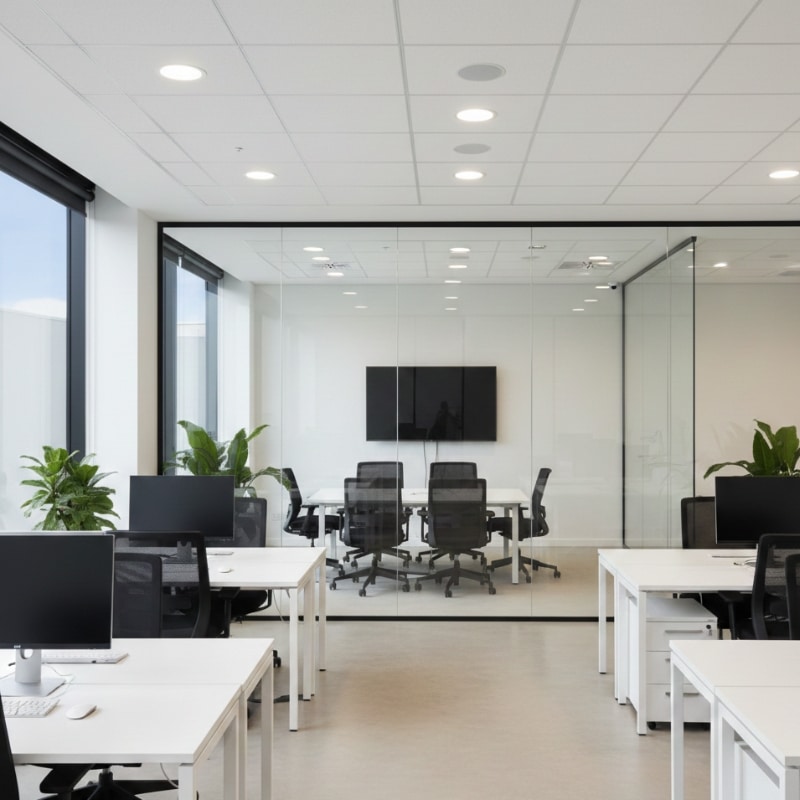
Small businesses in Melbourne often face the same challenge: how to create privacy, focus, and functional meeting spaces without making the office feel dark, cramped, or closed-in. Glass partitions are a popular solution, but planning them properly matters far more in a small workspace than in a large corporate fit-out.
This guide walks through a practical, step-by-step planning checklist for office glass partitions for small businesses, with a clear focus on layout decisions, realistic acoustic outcomes, and essential compliance considerations relevant to Melbourne offices. It’s written to help business owners, office managers, and decision-makers ask the right questions before committing to a design.
Why Glass Partitions Make Sense for Small Offices
Glass partitions work particularly well in smaller workplaces because they solve multiple problems at once.
- They maintain natural light across the entire floorplate
- They visually open up tight spaces
- They allow zoning without permanent walls
- They support flexible layouts as teams grow or change
In Melbourne, where many small businesses operate in leased tenancies with limited floor area, glass offers separation without sacrificing brightness or perceived space. Many businesses exploring glass partitions for offices find that the biggest benefit isn’t aesthetics—it’s flexibility.
Step 1: Define the Purpose of Each Space First
Before thinking about glass type, frames, or finishes, start with function. In small offices, every partitioned space often has more than one role.
Ask these questions early:
- Is this space for confidential conversations, or just visual separation?
- Will the room be used for meetings, phone calls, or focused work?
- How many people will typically use it at once?
- Is this a permanent function, or likely to change within a few years?
For example, a two-person meeting room used occasionally does not need the same acoustic performance as a boardroom used daily for client calls. Defining use upfront prevents overspending or underperforming later.
Step 2: Map Layout and Sightlines Carefully
In small offices, layout mistakes are amplified. A poorly placed partition can block light, create awkward corridors, or make the space feel smaller than it is.
Think About Light First
Natural light is often the primary reason businesses choose glass. To protect it:
- Position enclosed rooms along the perimeter where possible
- Avoid stacking multiple enclosed rooms in the centre of the floor
- Use full-height glazing strategically rather than everywhere
Clear sightlines from entry points also make small offices feel more open and welcoming, particularly in client-facing businesses.
Manage Traffic Flow
Glass partitions don’t eliminate physical barriers. Doors, frames, and junctions still affect how people move.
Check for:
- Door swings interfere with desks or walkways
- Narrow corridors created by over-partitioning
- Pinch points near kitchens, printers, or exits
These issues are especially common when office glass partitions for small businesses are planned late in the fit-out process rather than as part of the initial layout.
Step 3: Understand Acoustic Reality With Glass
One of the most common misconceptions is that glass partitions are either “soundproof” or “not acoustic at all.” The truth sits in between.
What Glass Can and Can’t Do
Glass helps reduce noise transfer, but outcomes depend on the full system, not just the panel.
Glass partitions can:
- Reduce general noise levels between zones
- Improve speech privacy when correctly detailed
- Support quieter meeting spaces in open offices
Glass partitions alone will not:
- Fully soundproof a room
- Stop vibration travelling through ceilings or floors
- Fix noise issues caused by poor room use or layout
Key Acoustic Factors to Plan For
If acoustics matter in your small office, pay attention to:
- Glass thickness and type
- Framing systems and seals
- Door choice (hinged vs sliding)
- Ceiling junctions and gaps above partitions
A meeting room with glass walls but a large open ceiling void will rarely perform well acoustically, regardless of glass thickness.
Acoustic Ratings in Plain Language
Acoustic performance is often described using ratings that can feel abstract. For small offices, it’s more helpful to think in terms of outcomes:
- Can people outside understand conversations?
- Does noise drop to a background murmur?
- Are calls disrupted by nearby collaboration zones?
In Australian offices, internal glass must meet safety requirements because people work, walk, and move close to glazed surfaces throughout the day. Government guidance on toughened safety glass highlights why glass used in internal walls, doors, and high-traffic areas needs to be selected and installed to reduce injury risk if breakage occurs. This is especially relevant in small offices, where circulation paths, desks, and meeting rooms are often positioned directly beside glass partitions rather than set back behind wide corridors.
Step 4: Choose Between Framed and Frameless Systems
Both framed and frameless glass partitions are common in Melbourne offices, but they behave differently in small spaces.
Frameless Glass in Small Offices
Frameless systems are visually minimal and maximise light. They suit:
- Offices prioritising openness and aesthetics
- Low to moderate acoustic needs
- Client-facing environments where first impressions matter
However, frameless systems rely heavily on precise installation and are more sensitive to ceiling and floor tolerances.
Framed Glass in Small Offices
Framed systems introduce slim structural elements around the glass. They can:
- Improve acoustic sealing
- Accommodate doors and hardware more easily
- Tolerate imperfect building conditions
In compact tenancies, framed systems often deliver more predictable results.
Step 5: Plan Doors as Part of the Acoustic Strategy
Doors are usually the weakest point in any partitioned room.
Consider:
- Hinged doors generally seal better than sliding doors
- Drop seals and perimeter seals improve sound control
- Door placement affects both privacy and circulation
In small meeting rooms, door detailing often matters more than upgrading the glass itself.
Step 6: Address Compliance and Safety Early
Compliance is not just a box-ticking exercise. In offices with glass partitions, it directly affects safety and usability.
Safety Glazing Selection
In Australian offices, internal glass must meet specific safety requirements. This typically involves toughened or laminated glass, depending on location and risk.
Key considerations include:
- High-traffic corridors
- Door panels and side lights
- Areas where people could walk into glass
Visibility and Manifestation
Clear glass must be visible to avoid collision risks.
Common solutions include:
- Frosted bands or dots at eye level
- Subtle patterns or gradients
- Company branding applied as film
In small offices, manifestation can also improve usability without compromising light.
Step 7: Think About Future Changes
Small businesses evolve quickly. What works for five staff today may not suit ten staff next year.
When planning partitions, consider:
- Can rooms be reconfigured without major demolition?
- Are partitions demountable and reusable?
- Will new power, data, or AV be needed later?
Many businesses that want to learn more about glass partitions start here—by understanding how adaptable the system will be over time.
Step 8: Coordinate With Services and Building Constraints
Glass partitions don’t exist in isolation. They intersect with:
- Air-conditioning diffusers and returns
- Fire sprinklers and detection
- Lighting layouts
- Power and data routes
In Melbourne offices, especially older buildings, these constraints often dictate final partition heights and layouts.
Frequently Asked Questions
Are glass partitions suitable for very small offices?
Yes, when planned carefully. They help maintain light and openness, which is especially important in compact spaces.
Do glass partitions reduce noise enough for meetings?
They can, but results depend on glass type, framing, doors, and ceiling conditions.
Is frosted glass required for compliance?
Not always, but clear glass usually needs some form of manifestation to ensure visibility and safety.
Can glass partitions be changed later?
Many systems are demountable and can be reconfigured, which suits growing small businesses.